Project Context
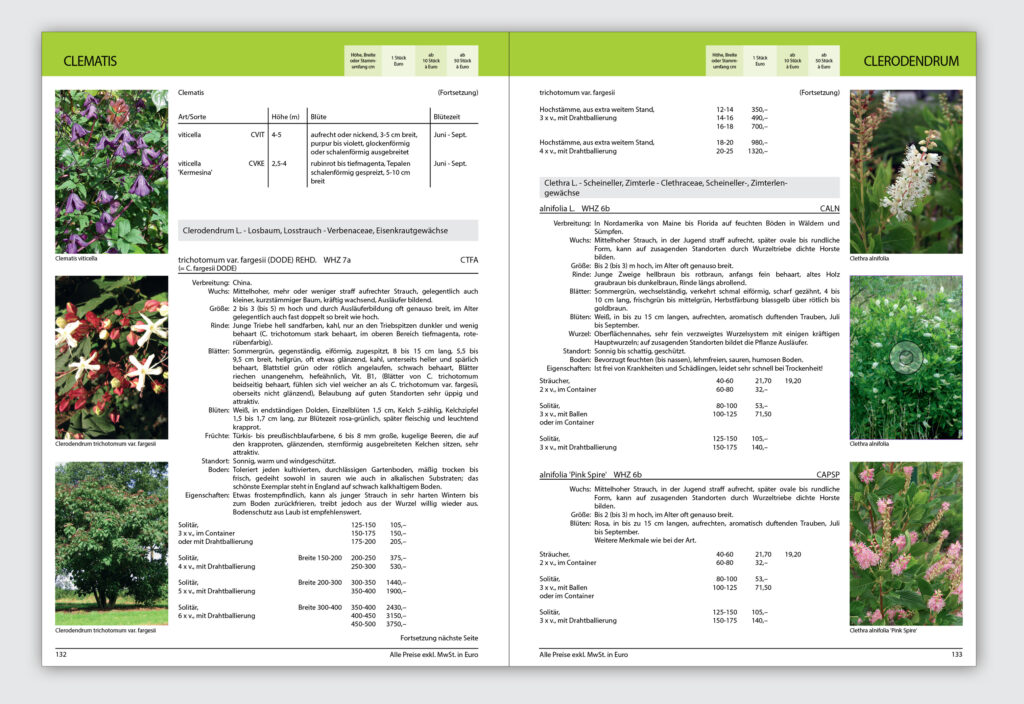
This case study documents the technical relayout and prepress optimization of a large, annual product catalog for trees and plants. The publication comprises approximately 1200 pages and is produced in four languages: German, English, French, and Russian. The total print run is around 16,000 copies, with 4,000 copies per language.
Legacy Production Setup
The project originated from a legacy production workflow based on QuarkXPress. Each language existed as a fully separate document, which made maintenance increasingly inefficient. Annual price changes, content updates, and corrections had to be repeated four times, while page alignment between languages could not be guaranteed. From a printing perspective, this structure also required a complete CMYK plate set for each language version, increasing both cost and production complexity.
Objectives of the Relayout
The goal of the relayout was not merely to migrate the catalog to Adobe InDesign, but to redesign the document architecture so that all language versions could be managed within a single production file. A central requirement was that every plant entry start on the same page number in all four languages, regardless of language-specific text length differences. This constraint applied across all chapters, from highly structured plant listings to more editorial sections such as design guides, climate zones, and reference content.
InDesign Document Architecture
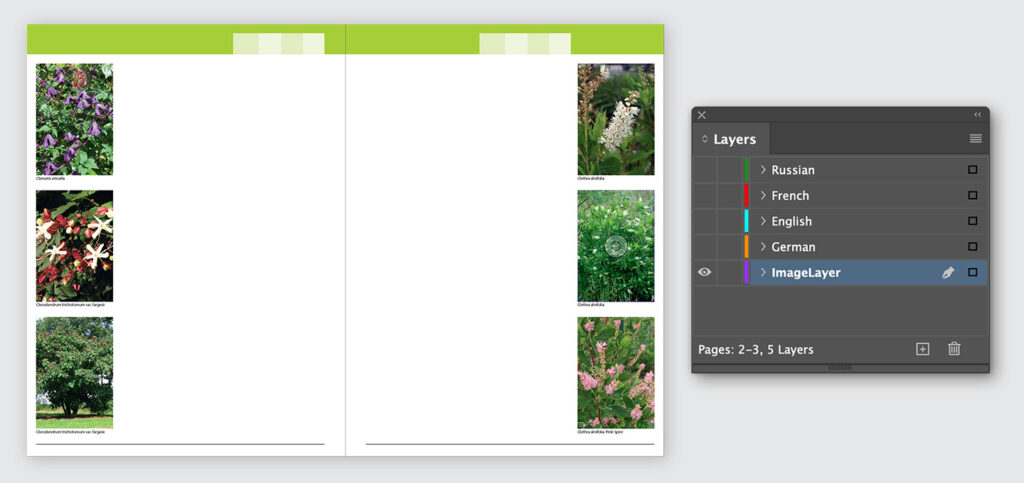
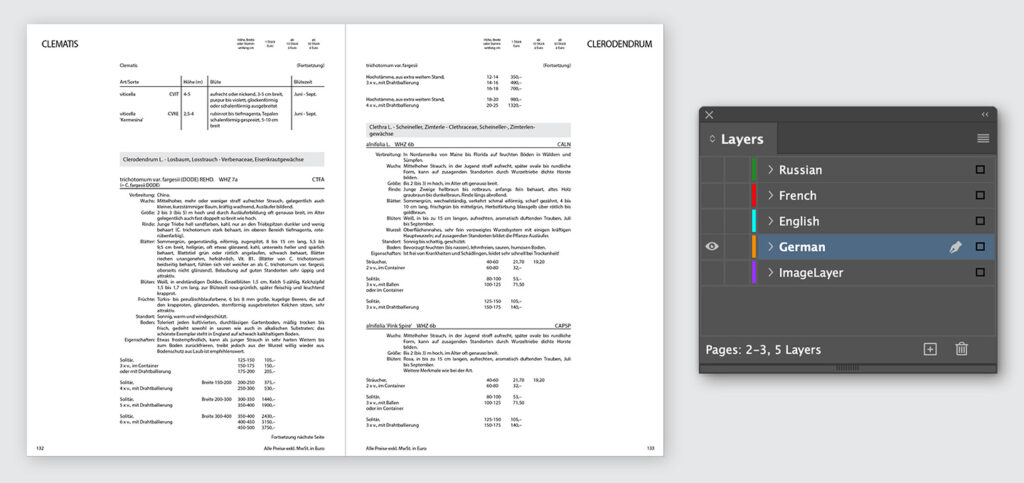
The new InDesign document was built around a separation-aware, layer-based structure. All images and graphical elements were placed on a dedicated bottom layer, while each language was assigned its own text layer above it. Text was strictly limited to black only, ensuring clean color separations and predictable plate output. This architecture allowed languages to be activated or deactivated at output stage without affecting layout, positioning, or pagination.
Typography and Pagination Control
Special attention was paid to typographic behavior and text flow. Paragraph styles, spacing rules, and frame geometry were engineered to absorb language-dependent text expansion, particularly in French and Russian, without causing reflow or page breaks. As a result, pagination remained stable across the entire 1200-page document, even when content and prices were updated.
Printing and Plate Optimization Strategy
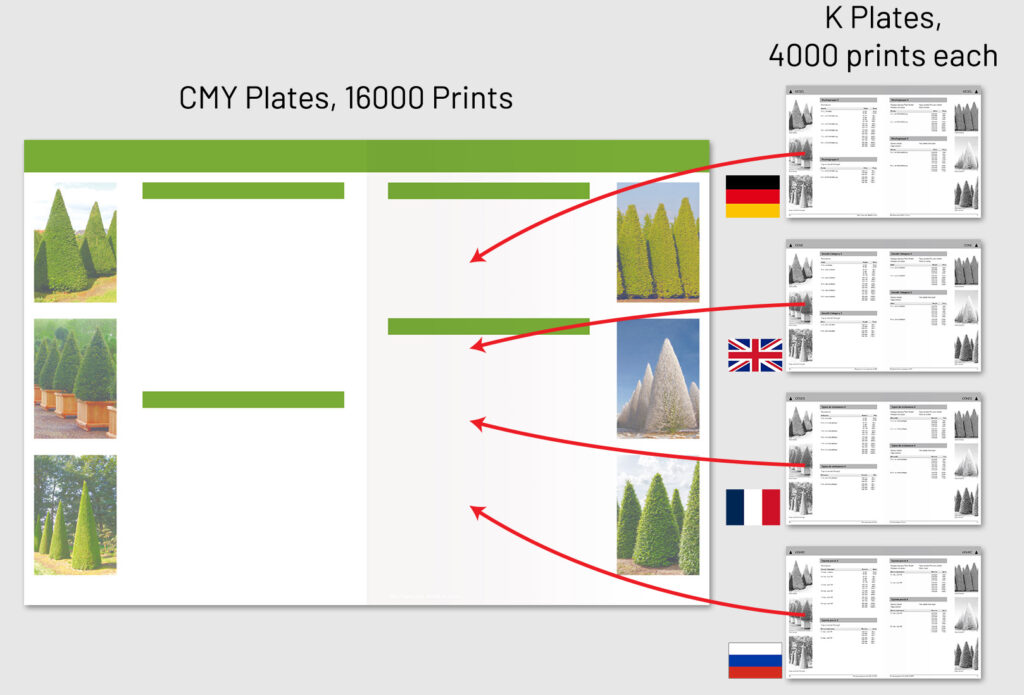
Beyond layout and document control, the most significant impact of this approach was achieved at the printing stage. Instead of producing a full CMYK plate set for each language, the catalog was prepared for a shared-plate workflow. Cyan, Magenta, and Yellow plates were printed once for the full 16,000-copy run, as they contained only shared image content. The Black plate, which carried all language-specific text, was printed separately for each language in runs of 4,000 copies.
This reduced the total number of printing plates from sixteen to seven: three shared color plates and four language-specific black plates. The file was prepared and verified to ensure precise registration, clean separations, and zero CMY contamination in text output.
Results and Measurable Impact
The optimized prepress strategy resulted in printing cost savings of approximately 30,000 euros per print run. Since the catalog is updated and reprinted annually due to changing plant prices, these savings accumulated year after year. Additional benefits included faster annual updates, fewer correction cycles, and significantly reduced production risk.
Yearly saving in printing
Prepress Conclusion
This project demonstrates how prepress-driven document architecture, combined with a deep understanding of printing processes, can directly influence production efficiency and cost. By treating layout, color separation, and plate strategy as a single system, a complex multi-language catalog was transformed into a stable, scalable, and economically optimized production workflow.
This case study reflects real-world, high-volume print production where technical prepress decisions were central to the success of the project.